Some of the most expensive problems in a house leave no visible trace. A slab leak under the foundation. Moisture behind a shower wall. A breaker running hot in a panel that looks completely normal from the outside.
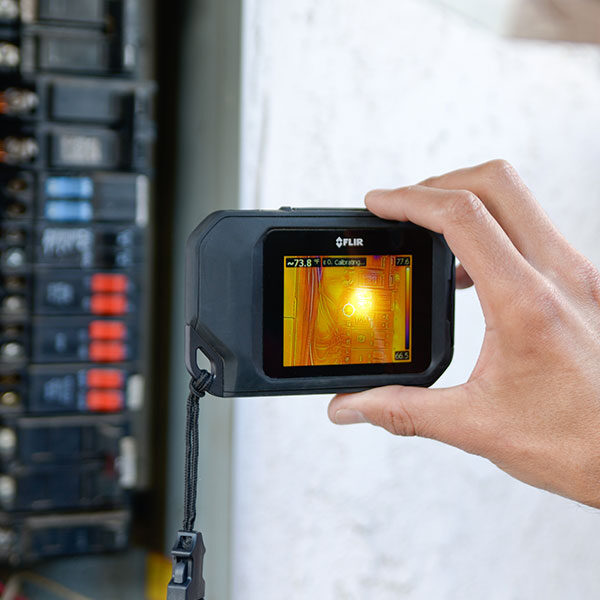
These conditions don’t announce themselves during a standard visual inspection — but they do change the temperature of the surfaces around them. Thermal imaging is how our inspectors find those temperature patterns, and how we confirm what’s actually behind them.
What can thermal imaging find during a home inspection?
Infrared scanning helps our inspectors locate:
- Moisture intrusion behind walls and ceilings
- Active plumbing leaks, including leaks beneath a concrete slab
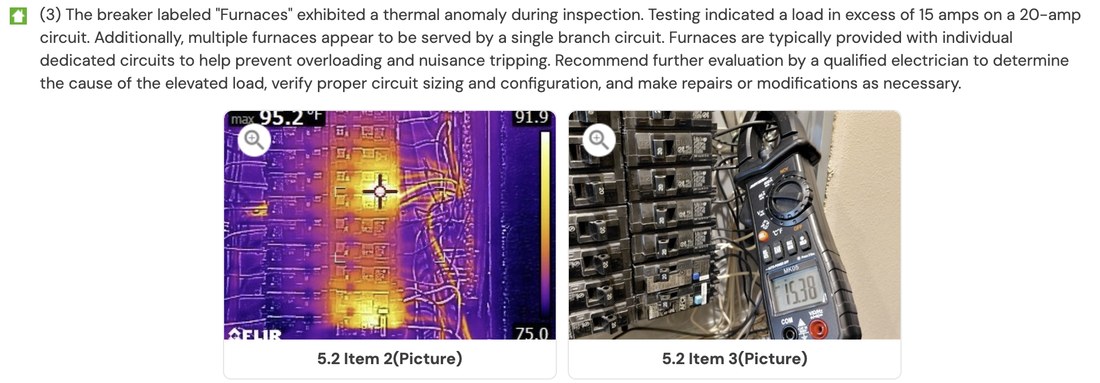
- Electrical components running hotter than they should
- Missing, settled, or failed insulation
- Gaps in HVAC distribution and air sealing
Where thermal imaging reveals concealed moisture, mold is often the underlying concern — see our mold testing & laboratory analysis service.
Where does the inspector scan?
Our inspectors scan main and sub electrical panels, accessible outlets and switches, bathrooms, kitchens, laundry areas, water heaters, ceilings beneath second-floor plumbing — and anywhere else the inspection turns up something worth a closer look.
What happens when the inspector finds a thermal anomaly?
This is where most infrared inspections stop. Ours doesn’t.
A thermal anomaly is a temperature difference. On its own, it isn’t a diagnosis — it’s a question. Plenty of them turn out to be nothing at all.
Under our Thermal & Infrared Enhancement Protocol, the inspector confirms what they’re seeing before it goes in your report:
- When the pattern suggests moisture, the inspector uses a moisture meter to verify whether readings are actually elevated
- When the pattern involves an electrical component, the inspector uses an amperage meter or other appropriate test equipment to measure what the circuit is genuinely doing
- Either way, the finding is documented with the thermal image alongside the confirming measurement
You don’t get a colorful photo and a shrug. You get an answer.
What can’t thermal imaging do?
Worth being direct about this.
An infrared camera detects surface temperature. That is the entire capability. It does not see through walls, it does not detect moisture directly, and it cannot identify an electrical defect on its own.
Any inspector who tells you their camera sees inside your walls is overselling the tool.
What infrared genuinely does is tell our inspectors where to look more closely. The value isn’t in the image — it’s in what we do after we take it.
Is thermal imaging included in a Morrison Plus inspection?
Thermal imaging is an add-on enhancement rather than part of the standard inspection. Every Morrison Plus location offers it, and we recommend it whenever concealed moisture or electrical conditions are a realistic concern — older homes, slab foundations, properties with past water damage or repairs, or anywhere you’ve noticed staining or an unexplained jump in the water bill.
Ask your local inspector to add it when you schedule. Pricing varies by market and property size.
Is thermal imaging worth it when buying a home?
The math is straightforward. A slab leak discovered after closing is commonly a five-figure repair, and it becomes entirely your problem the moment the sale completes. Found during the inspection period, it’s a negotiating item.
Thermal scanning doesn’t guarantee we find every concealed condition — nothing does. It meaningfully widens what we’re able to catch while you still have leverage.
Temperature tells us where to look. Testing tells us what’s there.
Add thermal imaging to your inspection
Mention it when you book and your local Morrison Plus inspector will include infrared scanning.