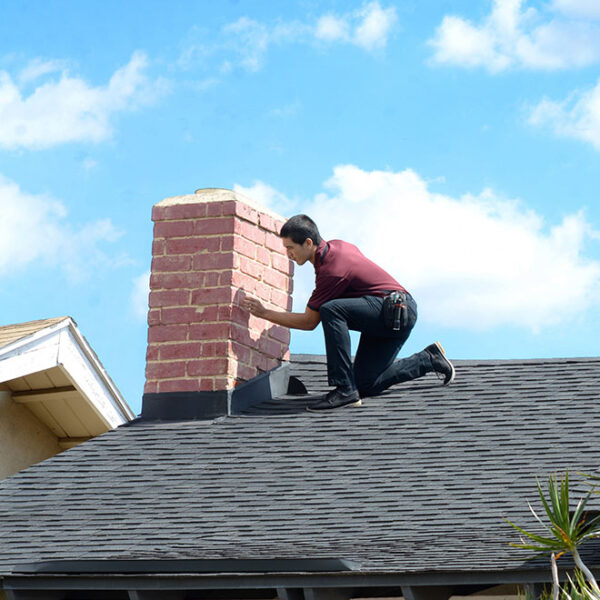
There’s nothing quite like a fire on a cold evening. A fireplace or wood stove is often the reason people fall in love with a house — and for many homes it’s a real source of heat, not just atmosphere.
It’s also one of the few things in a house designed to contain an open flame. That’s worth taking seriously.
What are the chimney inspection levels?
The chimney industry works from a common framework set out in NFPA 211, the national consensus standard for chimneys, fireplaces, and venting. It defines three levels of inspection. Adoption varies by state and jurisdiction — it isn’t part of the building code everywhere — but it’s the reference point professionals across the country work from.
Level 1 is the basic visual inspection. Readily accessible portions of the chimney exterior and interior, plus accessible portions of the appliance and connection. Appropriate when the system is in continued service, under the same conditions, with no known problems.
Level 2 is the transaction inspection. Everything in a Level 1, plus accessible attics, crawlspaces, and basements the chimney passes through, and video scanning of the internal flue surfaces. Under the NFPA 211 framework this is the level indicated when a property is sold or transferred, when the fuel type changes, or after an event that could have damaged the chimney — a chimney fire, an earthquake, a severe storm.
Level 3 is invasive. Removal of building components — masonry, siding, drywall — to reach a concealed area. Reserved for cases where a Level 2 found evidence of a serious hazard that can’t be evaluated any other way.
Which level do I need when buying a house?
A Level 2.
The industry standard set out in NFPA 211 indicates a Level 2 inspection at property transfer — not because anyone suspects a problem, but because the chimney is changing hands and nobody can vouch for its history. Whether that standard is written into local code varies by jurisdiction, but it’s the benchmark professional inspectors work to, and it’s what a buyer should expect.
The practical difference is straightforward: a visual look up from the firebox doesn’t tell you the condition of the flue. A Level 2 scans it with a camera. Everything above the smoke chamber — liner cracks, gaps at joints, glazed creosote, collapsed sections — is only visible that way.
That’s the part worth paying for.
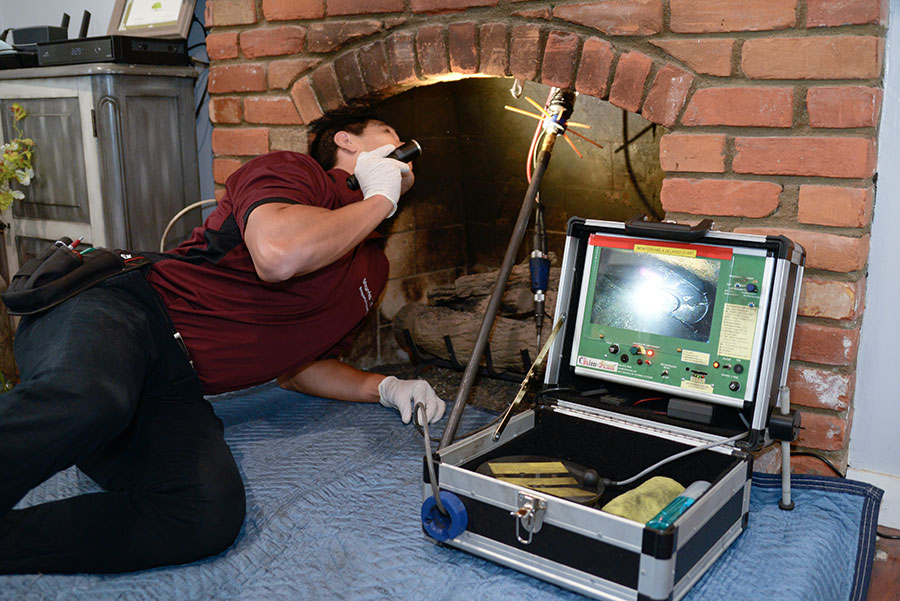
A Morrison Plus inspector looking up the chimney from inside the fireplace. This is the entire view from below — everything higher up requires a camera.
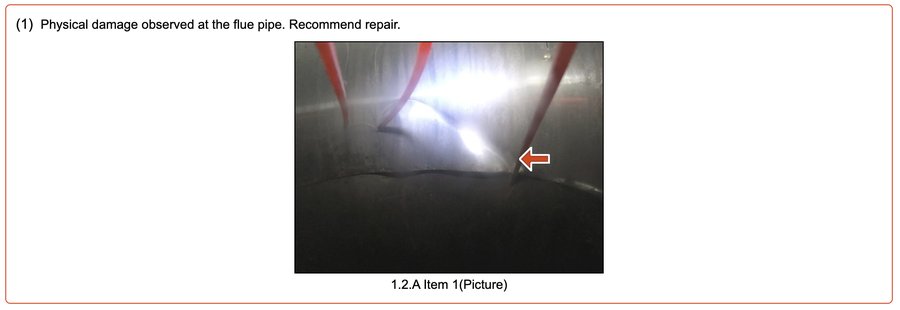
Internal flue damage from the vantage a camera provides. Actual Morrison Plus report.
What does your chimney inspection include?
Our chimney inspections are performed at Level 2:
- Video camera scan of the internal flue surfaces
- Exterior masonry, crown, cap, and spark arrestor
- Firebox, damper, smoke chamber, and hearth extension
- Flue liner condition, joints, and continuity
- Creosote accumulation and stage
- Clearance to combustible materials
- Draft testing of the fireplace to confirm it actually vents as intended
- Accessible attic, crawlspace, and basement sections the chimney passes through
- For manufactured fireplaces, comparison against the manufacturer’s installation specifications
That last item matters more than people expect. Factory-built fireplaces are listed systems — the manufacturer specifies exactly which components, clearances, and flue assemblies are permitted. Mixed or substituted parts are a common finding and they void the listing.
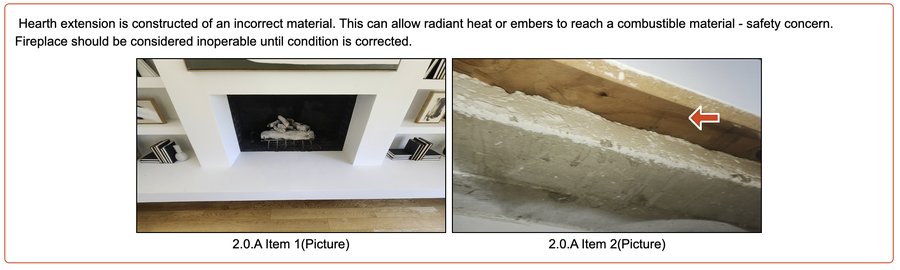
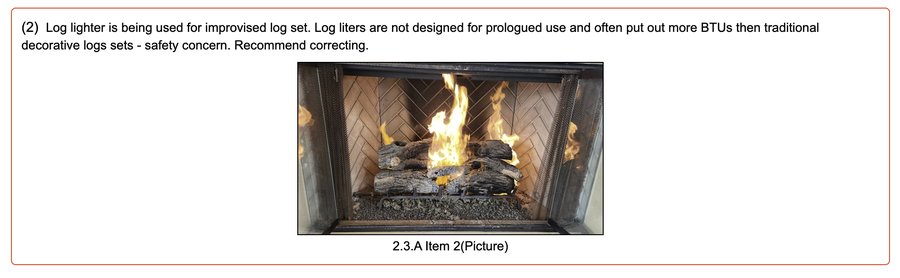
Incorrect hearth materials and improper log sets — the details that get missed.
Who performs your chimney inspections?
Our chimney inspections are performed by inspectors holding F.I.R.E. Service certification, a nationally recognized chimney and venting certification program.
Chimney evaluation is a specialty. A general home inspector without chimney-specific training is looking at the same firebox with substantially less to go on.
What is creosote, and why does it matter?
Creosote is the residue left behind when wood smoke condenses on a cooler flue surface. It’s flammable, and it accumulates every time you use the fireplace.
It builds in stages. Early creosote is a light, flaky soot that sweeps out easily. As it accumulates it becomes a hard, tarry deposit. In its advanced form it turns into a shiny, glazed layer that is extremely difficult to remove and burns hot enough to crack a flue liner.
A camera scan is how you find out which stage you’re dealing with. From the firebox looking up, you generally can’t tell.
What about carbon monoxide?
Carbon monoxide is the reason chimney inspections matter even in homes where nobody uses the fireplace.
Blocked, damaged, or improperly sized flues can allow combustion gases back into living space. Gas appliances — furnaces and water heaters — frequently vent through the same chimney structure, and those run year-round whether or not anyone lights a fire.
Nests, debris, collapsed liner sections, and missing caps are common findings, and every one of them is a venting problem before it’s a fireplace problem. Where a flue passes close to framing, our thermal & infrared enhancement can help reveal abnormal heat transfer.
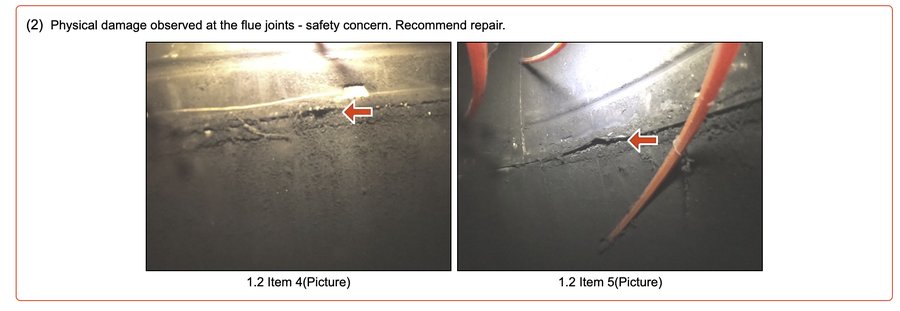
A physically damaged, separated metal flue joint. A gap like this can allow heat, combustion gases, and embers to reach surrounding framing — a fire and carbon monoxide hazard that should be corrected before the fireplace is used.
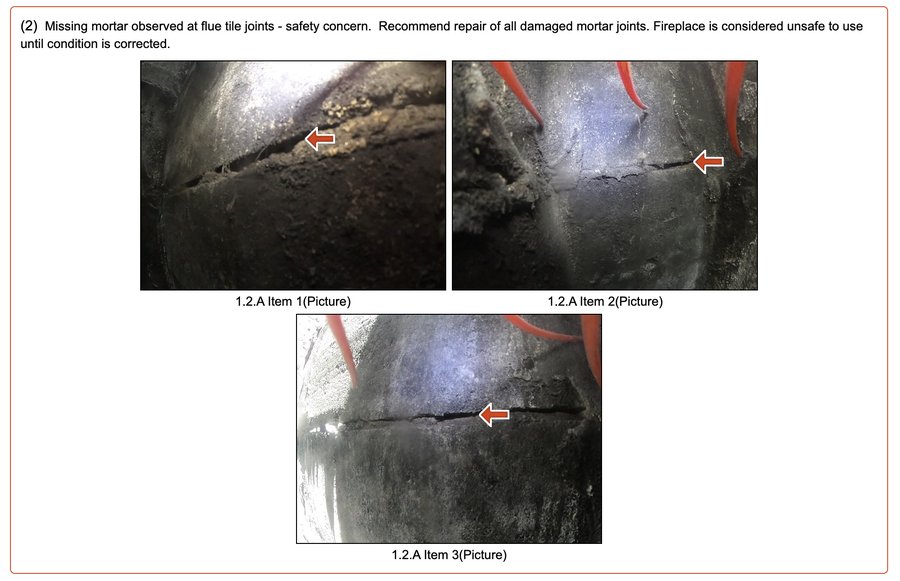
Missing and deteriorated mortar on a masonry chimney.
Do you also sweep or repair chimneys?
No. We inspect. We don’t sweep, reline, or rebuild — and that’s deliberate.
In much of the chimney industry, the company inspecting your flue is the same company that will quote the sweep, the liner, or the rebuild. That’s a direct financial reason to find something.
We don’t sell chimney work. We don’t take referral fees. We have no stake in what the camera finds.
What we give you instead is a documented assessment, images of anything we found, and where possible a fair estimate of what a repair should cost — so you can take that to a contractor of your choosing with numbers already in hand.
What do I receive?
- A written report with images of any findings
- Camera documentation of internal flue conditions
- Creosote accumulation and stage
- Draft test results
- For manufactured units, notes on any deviation from the manufacturer’s installation specifications
- Where possible, a fair estimated cost range for repairs
Is a chimney inspection included in a Morrison Plus inspection?
Chimney inspection is an add-on service rather than part of the standard home inspection, for residential and commercial properties alike. Every Morrison Plus location offers it. Ask us to include it when you book — pricing varies by market and property.
A chimney either vents or it doesn’t. The camera settles it.
Add a chimney inspection to your appointment
Ask us to scan the flue when you book your inspection.