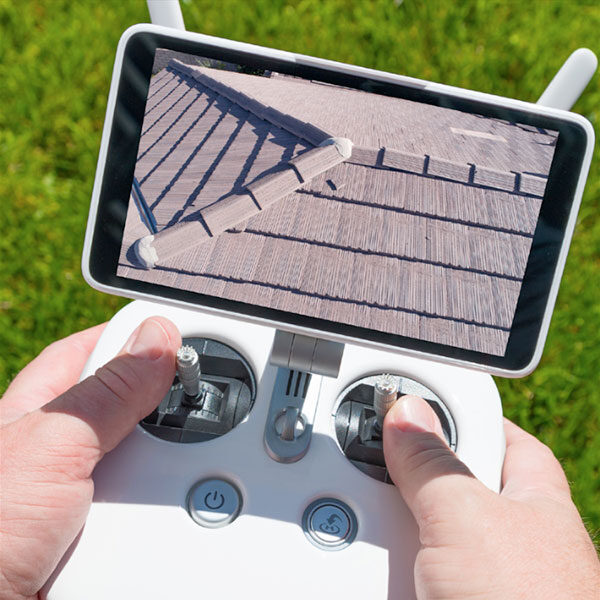
The roof is the most expensive component on most houses and the hardest one to actually look at. Plenty of roofs can’t be safely walked — too steep, too high, too brittle, too wet. And some roofing materials are damaged by the act of inspecting them.
A drone solves both problems. Our inspectors get a close, documented look at the entire roof surface without setting foot on it.
Why can’t the inspector just walk the roof?
Sometimes they can, and when conditions allow it, that’s part of a normal inspection. But a significant number of roofs can’t be safely or responsibly walked:
- Steep-pitch roofs where footing isn’t safe
- Two and three-story roofs with no safe access point
- Wet, icy, mossy, or debris-covered surfaces
- Roofs with deteriorated sheathing or unknown structural condition
- Concrete and clay tile, slate, and older composition shingle — materials that crack, slip, or lose granules under foot traffic
That last category matters in Southern California in particular, where tile is everywhere. Walking a tile roof to inspect it can create the exact defect you were hired to find.
Are your drone operators licensed?
Yes — and it isn’t optional.
Commercial drone operation in the United States requires an FAA Part 107 Remote Pilot Certificate. That’s federal law, not a best practice, and flying commercially without one exposes the operator to substantial civil penalties.
Morrison Plus company policy requires Part 107 certification of every inspector who flies. No certificate, no flight.
Part 107 covers airspace classification, weather, flight restrictions, and operating rules — the things that keep an aircraft out of controlled airspace and off your neighbor’s property. If someone is putting a drone over your house for money, they should be able to produce their certificate number on request.
Ours can.
What does an aerial view show that a ground inspection can’t?
The drainage plan. From the ground you see roof planes. From above you see how water actually moves — where valleys converge, where a plane dumps onto another plane, where a downspout discharges onto a roof surface instead of away from it, where debris collects at a transition. Drainage problems are the origin of most roof failures, and they’re most visible from directly overhead.
Cracked and slipped tiles. A single cracked tile in the middle of a field of two thousand identical tiles is nearly invisible from the ground and easy to miss even from a ladder. From overhead at high resolution, it’s obvious.
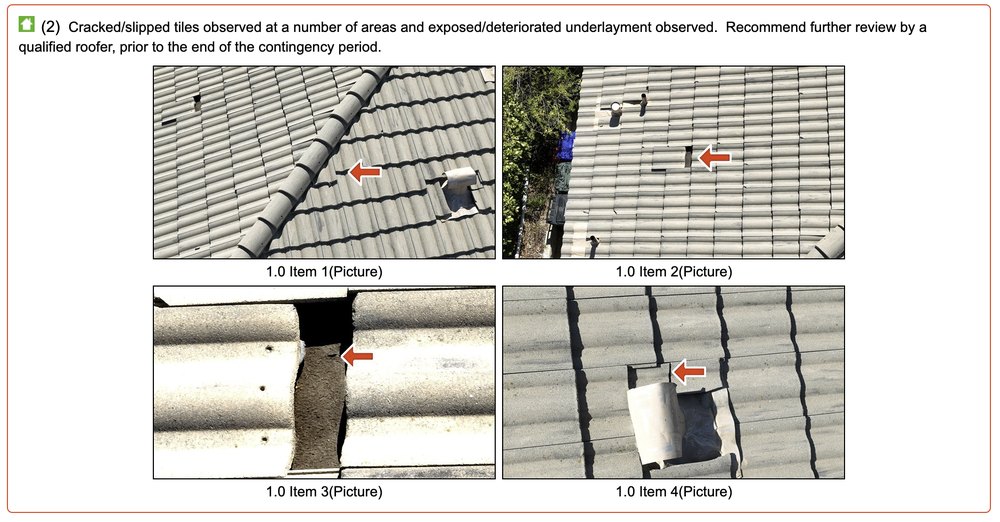
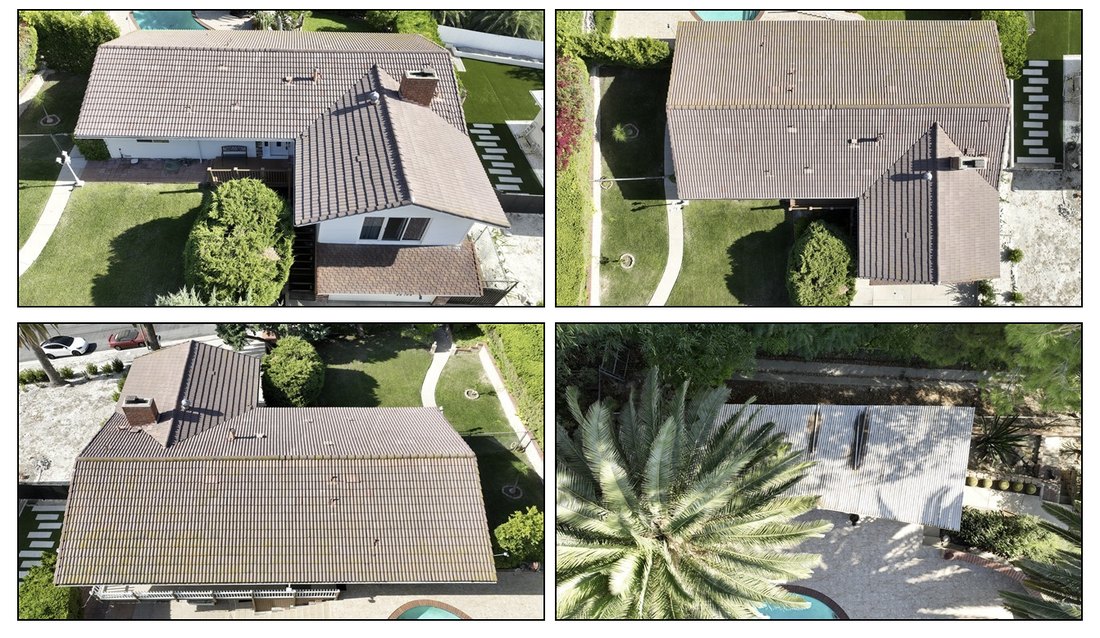
Cracked and slipped tiles with exposed underlayment, documented from the air. Actual Morrison Plus report.
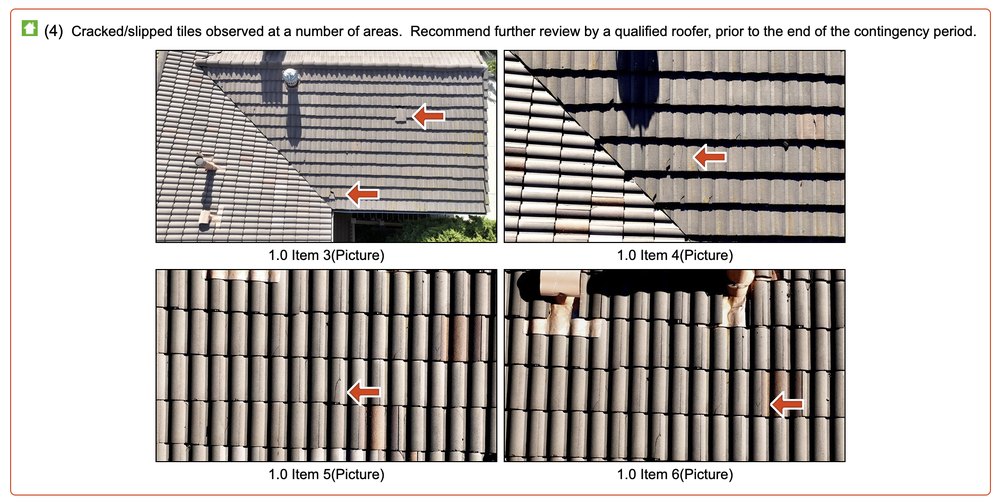
Hairline cracks and slipped tiles identified across multiple roof areas. Actual Morrison Plus report.
The parts of the roof nobody photographs. Rear slopes, upper roof sections above single-story wings, areas behind chimneys and mechanical equipment, and any plane that isn’t visible from the street or the yard.
What does the inspector document from the air?
- Overall roof geometry and the drainage path across all planes
- Cracked, slipped, broken, or missing tiles and shingles
- Exposed or deteriorated underlayment
- Condition of flashing at valleys, walls, and penetrations
- Chimney crowns, caps, and spark arrestors
- Vents, jacks, skylights, and mechanical penetrations
- Gutter and downspout condition and discharge points
- Debris accumulation and organic growth
- Prior repairs and patched areas
Does a drone replace a roof inspection?
No — it’s how the roof inspection gets done when the surface can’t be walked, and it adds a vantage point that walking never provides.
There are things a drone can’t do. It doesn’t lift a tile to check the underlayment beneath it, it can’t sound a soft spot underfoot, and it doesn’t see the underside of the sheathing from the attic. A complete roof assessment combines what’s visible from above with what’s visible from inside during the home inspection — and, where concealed moisture is a concern, our thermal & infrared enhancement.
Wind, rain, and restricted airspace can also ground a flight. If conditions don’t allow it, your inspector will tell you what was and wasn’t evaluated.
Is it safe?
Safety is the reason the service exists.
The alternative to a drone is a person on a ladder on a steep or brittle roof. Falls are among the most common serious injuries in this trade, and no roof inspection is worth one.
Our operators fly under Part 107 rules, maintain visual line of sight, respect controlled airspace and flight restrictions, and don’t fly in weather or airspace that would make the flight unsafe. When a flight can’t be conducted safely, it isn’t flown — and your inspector documents what could and couldn’t be evaluated.
Is drone inspection included in a Morrison Plus inspection?
Aerial drone inspection is an add-on service rather than part of the standard inspection. Ask us to include it when you book — pricing varies by market and property.
Some roofs shouldn’t be walked on. All of them should be looked at.
Add an aerial roof inspection to your appointment
Ask us to include a drone roof inspection when you book — especially for steep, tall, or tile roofs.