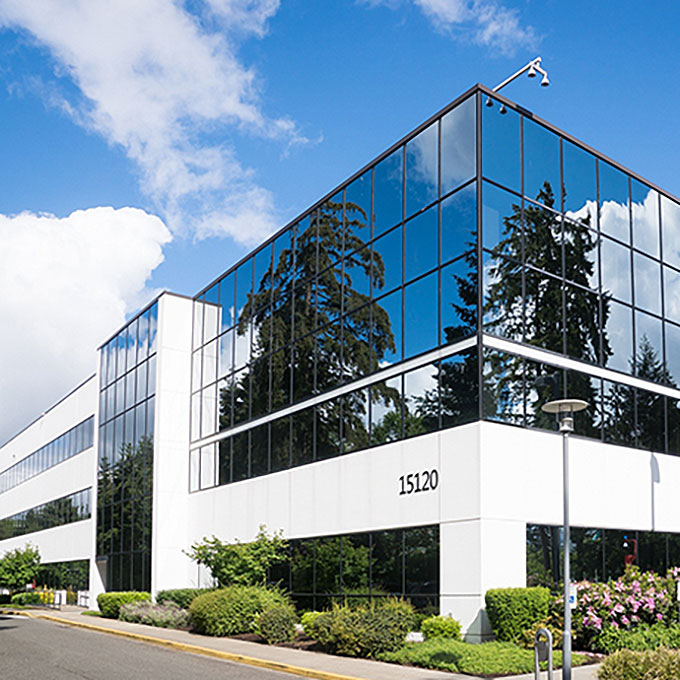
For commercial buyers, investors, brokers, and lenders, your due diligence is only as sound as the building underneath the numbers. That’s what we document.
CREIA member · ASHI member (Duane Morrison, ASHI Board of Directors) · Affiliate Member, Southern California CCIM Chapter
What is a commercial building inspection?
Morrison Plus Property Inspections performs commercial building inspections across Southern California and beyond — a visual, non-invasive evaluation of a commercial property’s readily accessible systems, documented in a detailed, photo-rich report. We’ve inspected hundreds of commercial buildings, from tilt-up warehouses to multi-tenant retail and office properties.
What types of buildings do you inspect?
Apartment complexes (5–30 and 31–100+ units), light-industrial and tilt-up facilities, warehouses, retail centers and strip malls, schools and churches, restaurants, medical clinics, office buildings, and parking structures — including national retail-chain locations.
What’s in a Morrison Plus commercial report?
Executive Summary
A concise, front-loaded overview of the building’s condition and the findings that matter most — so a decision-maker can grasp the picture in minutes.
General Conclusions
Our professional assessment of the property as a whole: its stage of life, how it has been maintained, and the issues most likely to affect its value or your budget.
Five-Year Estimated Cost to Cure
For larger and multi-tenant properties, our expanded engagement includes an estimated cost to correct significant deficiencies, looking five years forward — realistic numbers for your underwriting, capital planning, and price negotiation, not just today’s dollars.
System-by-System Findings
Detailed observations and photographs covering the site and grounds, structure, roofing, electrical, plumbing, HVAC, interiors, and more.
Cost-to-cure figures are estimates prepared to support your budgeting and negotiation. They are not contractor bids. Actual costs vary with contractor, scope, and market conditions.
What are the two ways we can inspect your property?
Type 1 — Standard Commercial Inspection. For smaller buildings. System-by-system findings, executive summary, and photo documentation.
Type 2 — Commercial Inspection with Capital Reserve Analysis. For larger and multi-tenant properties. Everything in Type 1 plus general conclusions and the five-year estimated cost to cure.
Do you perform Property Condition Assessments (PCAs)?
Yes. Our Morrison Plus commercial team performs Property Condition Assessments, using ASTM E2018-24 as a guide, and travels to properties throughout our network’s territories. For most commercial buyers and investors, our standard commercial building inspection — with its executive summary, general conclusions, and optional five-year cost-to-cure — delivers the due-diligence detail you need. Where a lender or transaction specifically calls for a PCA, tell us your property and timeline and we’ll arrange it through the commercial team.
What does the inspection include?
- Site, paving, drainage, and grading
- Structure and foundation, including concrete tilt-up panels and visible connections
- Roof coverings, drainage, penetrations, and rooftop equipment
- Exterior cladding, doors, windows, and loading-dock equipment
- Interior finishes, ceilings, stairs, and railings
- Electrical service, distribution, and visible wiring
- HVAC equipment — type, age, and apparent condition
- Plumbing supply, waste, and water heating
- Readily apparent ADA-related barriers (observations only, not a compliance survey)
What is not included?
The exclusions are a trust signal, not fine print. We do not inspect or determine:
- Fire-extinguishing and suppression systems (sprinklers, fire pumps, ESFR) — we note presence and apparent type and refer you to a licensed specialist
- Elevators, escalators, lifts, and dumbwaiters
- Communication, computer, security, and low-voltage systems
- Code, ordinance, or accessibility-standard compliance
- Environmental conditions of any kind
- Structural, geological, hydrological, soils, or land-survey matters
- The adequacy, efficiency, or remaining life of any component
- Concealed or inaccessible conditions
What should I know about tilt-up and industrial buildings?
No out-of-state firm knows this market the way we do. Roof-to-wall anchorage is the defining tilt-up vulnerability — roughly 400 tilt-up structures were significantly damaged in the 1994 Northridge earthquake, with deficient anchorage the primary concern. We look at what the records and conditions tell us relative to LA City Building Code Chapter 91 and LA County Chapter 95 retrofit ordinances (what to request, not a compliance determination), plus clear height (measured to the sprinkler deflector), slab condition, electrical service capacity for automation and EV charging, dock levelers and door counts, truck-court depth for 53-foot trailers, column spacing and impact damage, and roof membrane age, ponding, and warranty. Where you need a Phase I environmental assessment, a structural engineer, or a fire-protection contractor, we’ll point you to it.
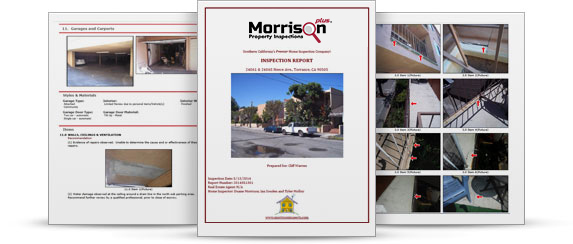
See a sample commercial inspection report
View a full sample commercial inspection report ›
The sample is a standard commercial building inspection report for an industrial tilt-up warehouse. The five-year cost-to-cure table is part of the Type 2 engagement for larger and multi-tenant properties and is not shown in this standard sample.
How long does it take, and what does it cost?
Pricing is based on square footage, age, and building type; timing scales with the size and complexity of the property. Contact us for a quote on your building.
What areas do you serve?
Southern California — the San Gabriel Valley, the foothills, the Inland Empire, and greater Los Angeles — and beyond, through the Morrison Plus network.
Contact Morrison Plus Property Inspections now for your commercial inspection needs.